Begin your journey at 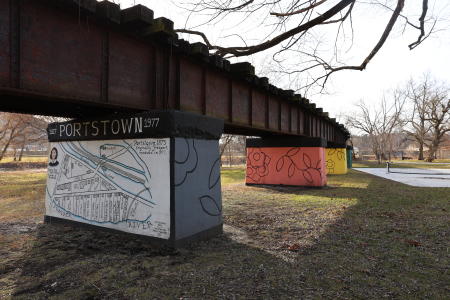 Portstown Park (842 Penn St, Huntingdon, PA 16652), a scenic riverside space along the Juniata River. Beyond the walking path, playground and other recreational offerings, the park features a series of murals painted on the old railroad trestles. Originally painted in 2003 by artist Matt D’Alberto in collaboration with local elementary students, these murals commemorate the former Portstown neighborhood and H&BT Railroad.
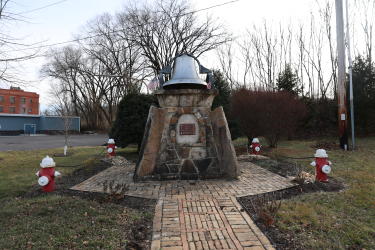
Just through Portstown Park’s pedestrian arch towards Penn Street stands the Huntingdon Fire Fighter Monument. Featuring the town’s original fire bell, this monument pays tribute to the men and women who have dedicated their lives to protecting the community.
On the corner of Penn and Eighth Streets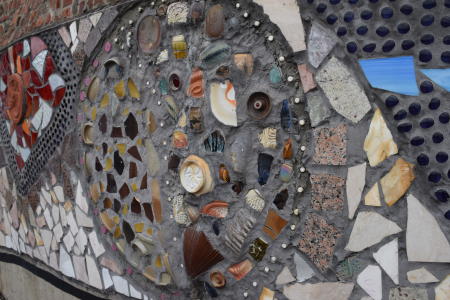 are two mosaic murals: “Pieces in Time” and "Paper Trail". “Pieces in Time” provides an artistic interpretation of Huntingdon's historic timeline. From right to left, each medallion symbolizes a specific time period. “Paper Trail” is dedicated to the role paper played in the community, including the invention and manufacture of the paper tablet by J.C. Blair in Huntingdon.
The J.C. Blair and the Mainline Canal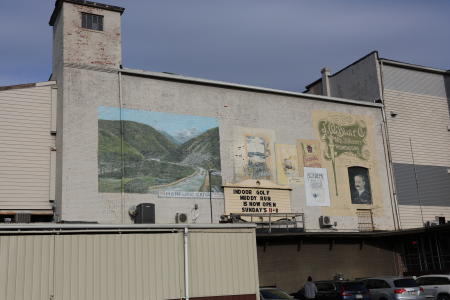 murals can be found on the back of Muddy Run Tavern and Twice Upon A Time (708 Washington St, Huntingdon, PA 16652). As the name suggests, this series of murals pays homage to two major sources of Huntingdon's prosperity. The first further memorializes J.C. Blair’s invaluable contributions to the area. The Mainline Canal mural captures a time when Huntingdon was a bustling stop along Pennsylvania’s canal system. Before railroads took over, the Juniata Division of the Mainline Canal connected communities and fueled economic growth, with canal boats carrying everything from raw materials to finished goods.
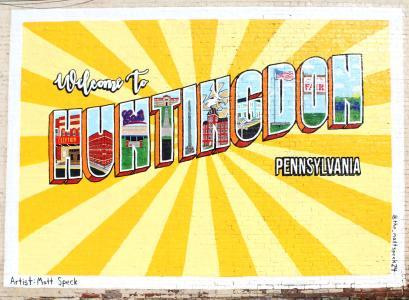
Located in Bryan Park (517 Washington St, Huntingdon, PA 16652), the Huntingdon mural offers a colorful introduction to the community. Designed as a photo-worthy backdrop by local artist Matt Speck, the mural highlights community staples such as Huntingdon Cinema’s Clifton 5, Juniata College and the Huntingdon County Fair.
Near the corner of Fifth and Penn Streets,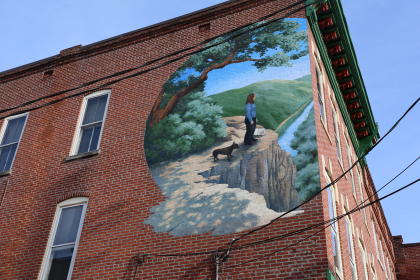 The Cliffs murals draw inspiration from a landscape that has shaped Huntingdon’s story for generations. The sandstone cliffs along the Juniata River have long served as both a visual landmark and a source of artistic inspiration, appearing in works like Thomas Moran’s The Juniata Evening in the mid-1800s. Over time, the cliffs have overlooked the evolution of transportation in the region from canals to railroads to modern highways, making them a lasting symbol of place and progress. A hidden “Paper Trail” detail ties the mural back to Huntingdon’s industrial roots.
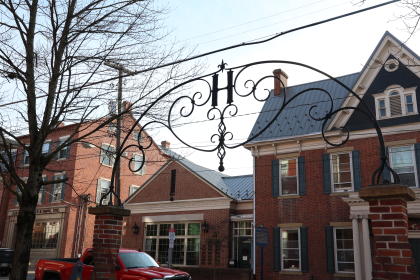 Located at Fourth and Penn Streets, “Arch and Pillars” was created by local blacksmith David Berger. The piece honors Huntingdon’s brick and iron heritage while creating a striking gateway into downtown through a collaboration between the Borough and the Arts Council.
On the side of 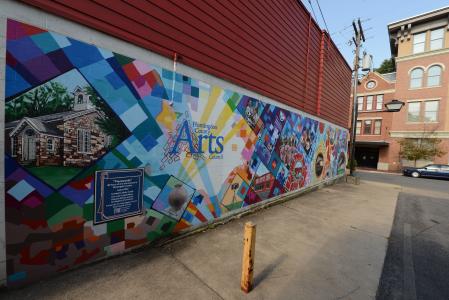 212 Fourth Street is “Pieceworks”, a community-driven mural celebrating the impact of the Huntingdon County Arts Council. Created in 2012 for the organization’s 40th anniversary, the piece was designed by Centre County artist Elody Gyekis and brought to life through hands-on participation from local artists, youth and residents.
The Standing Stone (Penn St & 3rd St, Huntingdon, PA 16652)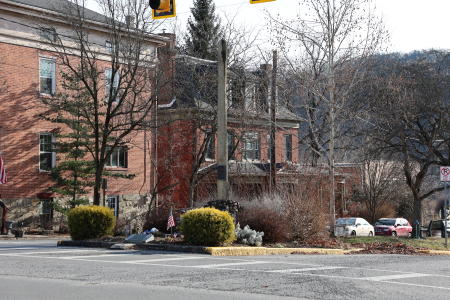 reflects one of Huntingdon’s earliest and most meaningful landmarks. Named for the original stone that once stood along the Juniata River, it’s believed to have served as a guidepost for Native Americans and early travelers. The landmark was so significant that the town was originally known as Standing Stone before being renamed Huntingdon. Today, it stands as a lasting symbol of the area’s deep history and the foundations of the community.